

Karmapa, India, Circa 2011


With the Dalai Lama, India 1999 Shortly after the Karmapa's escape from Tibet
Tsurphu Monastery, Tibet
With masters from Karmapa's lineage
Situ Rinpoche to his right and Gyaltsab Rinpoche to his left. Tsurphu, Tibet
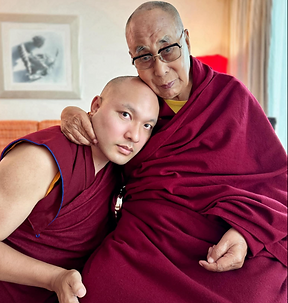

Karmapa and Dalai Lama, Switzerland September 2024
The kind of tent nomads like the Karmapa's family live in. It is made out of the hair of Yak and is very hardy.


Karmapa with Tibetan leader Dalai Lama, India
Tsurphu Monastery, seat of the Karmapas & home of the seventeenth Karmapa from the time he was recognized in 1992 until he left for India in 1999.
The seventeenth Karmapa was born in 1985 to a nomad family in Kathok, eastern Tibet. He was discovered by the search party in 1992 using centuries old method of recognizing reincarnation of successive Karmapas. The search party was using a riddle like letter left by the 16th Karmapa who died in Illinois, USA in 1981. Soon after his discovery, the 17th Karmapa was brought to central Tibet and enthroned at Tsurphu Monastery which is the seat of the Karmapa. It was built by the first Karmapa in 1159 AD. The 17th was separated from his parents ever since was taken from his own home. He was brought up by monks at Tsurphu who gradually became his familfy. He received his basic education from them. In 1999, Karmapa decided to escape Tibet because his movements were severely restricted by the Chinese. Even though the Chinese authorities accepted the Dalai Lama's recognition of him, he was not able to leave Tsurphu to receive important teachings and transmission from the masters of his lineage. They were almost all outside Tibet. Similar to other major religions of the world, Tibetan Buddhism has several sects but among them the four most well known are the Gelug to which the Dalai Lama belongs. Dalai Lamas have also been the head of the people of Tibet since the time of the fifth Dalai Lama. The present Dalai Lama democratized the Tibetan governing system in exile and relinquished his position as the political head. Karmapa belongs to the Kagyu sect. The other two are Sakya and Nyingma. The latter two could have nonmonastic heads too. It was relatively more relaxed in Tibet in the 1990s and a few people were able to go in and out of Tibet with some ease. Karmapa's own regent and one of his principal teachers and others came to Tibet for his enthronement at Tsurphu. But soon he was put under more restriction by the authorities. In fact, he was effectively not allowed to leave the confines of the monastery.
So, even though it was extremely difficult for him to eave Tibet and everyone behind: people of Tibet, monks of Tsurphu, his parents and family members, he decided to flee because without the proper lineage instructions and transmissions from the masters in his tradition, his education as the head of his sect would have been incomplete.
The 17th Karmapa made his daring escape from Tibet in 1999. At the time of his escape he was only 14 years old. On December 28, 1999, he left his monastery by climbing down from his room and jumping onto the roof of a nearby shrine room. He then leapt to the ground where a jeep was waiting. The escape party, which included the Karmapa and four others including another lama, drove through the night, avoiding check posts and army camps by taking back roads through the hills and valleys. They reached Mustang, Nepal, and continued their journey on foot across dangerous, freezing paths till they crossed the border. The account of his harrowing journey is found in the book Music In the Sky by Michel Martin. Karmapa arrived in Dharamsala, India in January 2000. He went directly to meet the Dalai Lama, who had also escaped from Tibet in 1959. The escape was a significant discomfort for the Chinese government, which had agreed to the Dalai Lama's recognition of him. Many think it shrewd of China to have such an important lama like the Karmapa to be recognized by the Dalai Lama. Earlier, when they disappeared the child Panchen Lama recognized by the Dalai Lama and replaced him with their own pick, it didn't work because the Tibetans haven't accepted him.
Karmapa left a written message behind when he escaped. In it he stated that he had made many attempts to obtain permission to travel abroad which did not bear fruit and that this was the last resort. He expressed the hope that if he could be beneficial to Tibet in the future, he would return soon. He left with his letter one to him from the Dalai Lama. And this is what he said about it, "He asked me to study well and serve the teachings in Tibet. I thought it would be good to leave this letter along with mine." Music in the Sky (Martin, 93) His escape raised tensions among the Chinese government, the Dalai Lama’s administration, and the Indian establishment. A handful in Indian media, most likely with dubious motive, speculated that his escape was either facilitated by the Chinese or orchestrated by Dharamsala. There are some in Indian media and position of influence enamored by Maoist thought who are not sympathetic to Tibetan causes. This adverse media slant caused him great many challenges and once again he was confined to Gyuto Monastery in Dharamsala. Gyuto is a Gelug monastery and Karmapa is of the Kagyu sect. The monks of Gyuto provided him a place to live, study. His teachers and masters of the lineage came there to teach and to pass onto him important lineage teachings, transmissions, and empowerments and so on. He also met there people who came to see him from all over the world. But he was not allowed to move freely by the Indians. It was only eight years after his arrival in India he was finally able to travel to the west.
When he first arrived in Dharamsala, the Dalai Lama appointed a great scholar and practitioner from the Karmapa's own tradition, Thrangu Rinpoche, as his tutor. Sadly Thrangu Rinpoche died in 2023.
The information about the Karmapa is based mainly on the anecdotes from his life that he shared during teachings and lectures over the years and the book about him Music in the Sky: The Life, Art & Teachings of the 17th Karmapa Ogyen Trinley Dorje by Michele Martin.
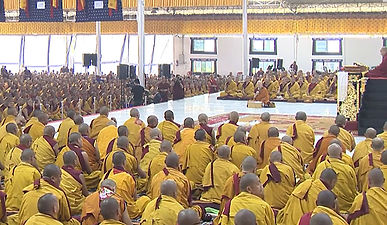
At Kagyu Monlam, India 2015

At North American Kagyu Monlam, USA 2018